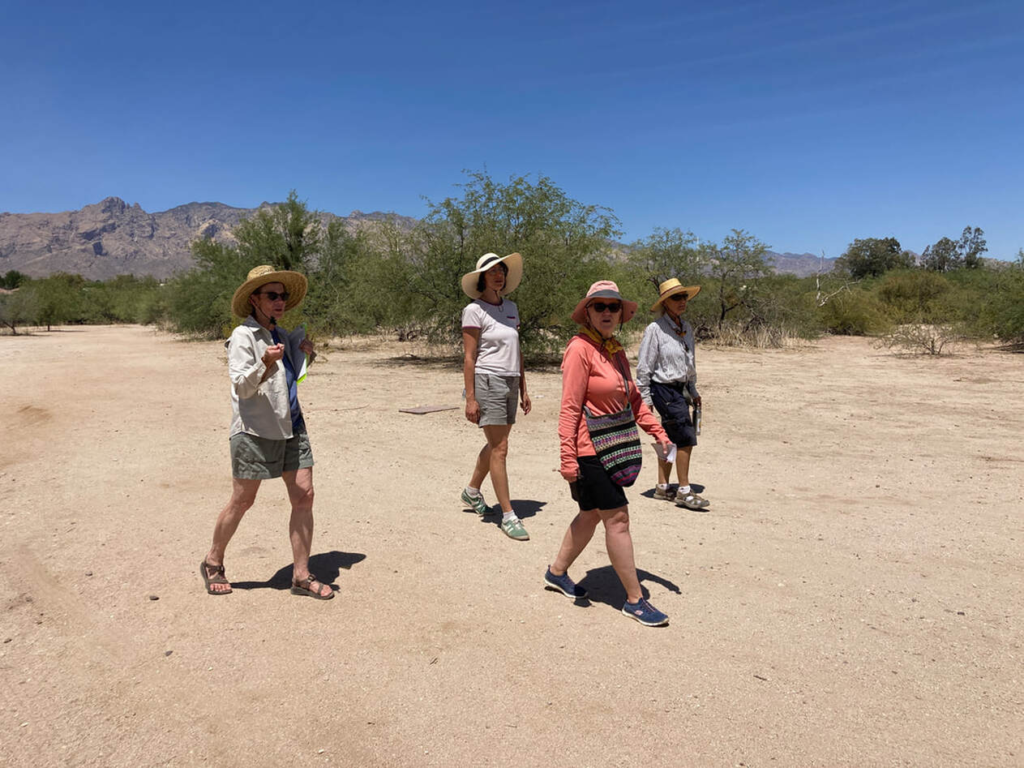
On Monday May 23rd, we met with Elise Gornish for a walk-through of Rio Vista Park . Our goal for the meeting was to figure out a strategy for restoring the vegetation at Rio Vista and to gather some ideas.
Elise Gornish is a restoration ecologist who works for the UofA School of Natural Resources and the Environment. Her job is to help people like us, and that is what she did. She is full of useful and fantastic information. The meeting will, no doubt, be one of many.
Some of the main messages to us are:
• We cannot do it all at once.
• We need to pick areas that have increased chances of surviving, areas such as under established trees (islands of fertility) or areas where water is apt to flow.
• We should pick a visible area, call it out to the visitor, make it an educational opportunity.
• We need to choose plants that grow quickly: mesquite and desert broom, for eg.
• A candidate species list will be created using the tool on ecorestore.arizona.edu.
• Once shrubs have been established, seed.
• Cactus make great barriers.
• Reach out to local nurseries and non-profits for plants and labor. Some of the organizations mentioned: Tucson Audubon, Bat Conservation International, Pima Prickly Park, Tucson Cactus and Succulent Society, and Hawk Watch International.
Educate and get the public involved.
• Signage should inform and provide a reason why a trail is closed, for eg.
• Engage the visitor (a potential citizen scientist) in documenting a selected site by taking photos and uploading them to create a visual timeline of the site’s growth.
• Create workshops on ways to help the park. One fun workshop idea, which Elise has offered to run, is to create seed balls. Seed balls are made of mud, seed and organic matter like horse manure. We’ve decided to name the activity “poop pourri”. Hope to see you there (in July before the monsoons)!
For more about information about Elise’s work, visit https://www.gornishlab.com
Walk-through Meeting with Elise Gornish, May 23, 2022