
by Murray DeArmond
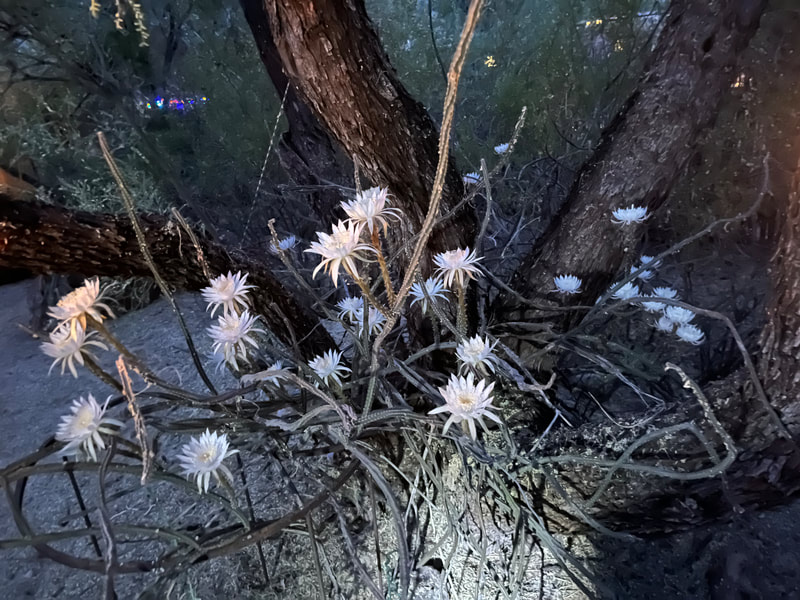
When we moved here nearly 50 years ago, we were surprised to see a skeletal plant full of white flowers hidden behind an ancestral mesquite tree, located in the back parts of our property near our chicken coop. Even though the sweet-smelling flowers were spent after just one day, the plant was so unusual and spectacular, we decided to move it to a more visible location in order to better keep track of the bloom cycle the following year. When our younger son and I dug around the base of the plant to initiate the transplantation, we soon learned an important lesson. We began to uncover an enormous tuber, the likes of which we had never seen before. Fortunately, we replaced the soil and abandoned the job. It was a good decision as we later learned that these tubers, like huge turnips, can be enormous and weigh up to 100 pounds! Through all these years, the above-ground plant hasn’t changed a lot. All but one day of the year, the plant looks like dead, burnt sticks coming out of the ground and branches. Our Queen has faithfully bloomed one night each year since we’ve lived here.
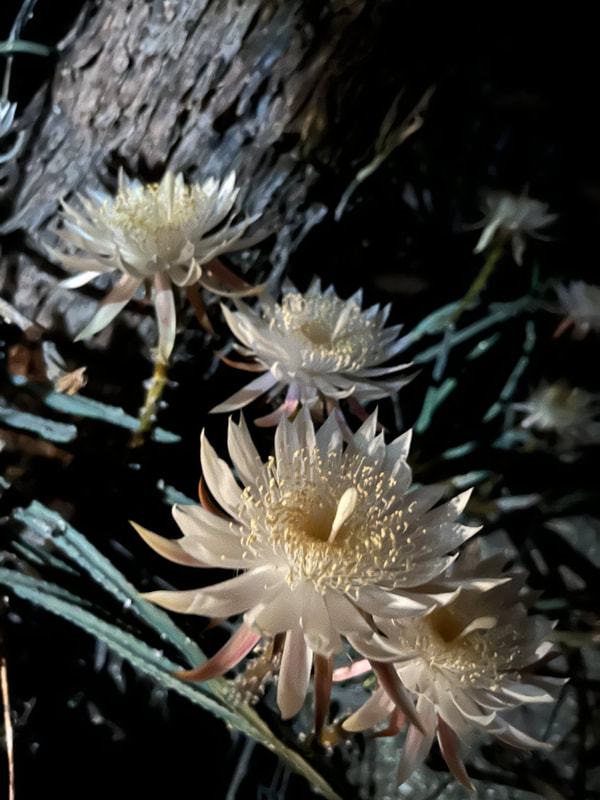
One evening we were driving home and heard on AZPM that Tohono Chul was initiating a public celebration of the Queen’s appearance in their gardens. We had been following the progress of ours and didn’t think it close to blooming. After we returned home, we checked and, to our surprise, it was also in full bloom. How these plants can bloom on the same, single night out of the year remained a mystery to us. Our neighbor suggested a phenomenon called quantum entanglement* might help to answer the question.
For a number of years, we had a small ritual celebration of the annual bloom. Neighbors and friends get together; sometimes we read the legend; sometimes we toast the Queen; and always we are amazed at this desert miracle.
The Legend...
By Trica Oshant Hawkins
The primary ecological reason for blooming all at once is essentially an economics of scale. When a plant and its pollinators are not particularly abundant, synchronous blooming of all individuals of that species increases their potential for cross pollination and subsequently decreases the probability that an individual’s fruits will be preyed on (since they would all be fruiting at the same time as well). All this ultimately increases the total seed production, and hence survival, of the species.
While all that makes sense and provides scientific explanation, it doesn’t clearly explain just what environmental cues are stimulating this simultaneous blooming. There are studies that suggest several plausible reasons, including changes in intensity of solar radiation, humidity, photoperiod, temperature, and stress. Additionally, it is important that there are enough pollinators present to make blooming worthwhile and thus, it has been posited that there may be chemical communication cues when pollinator numbers are optimal. These factors may indeed affect plants that are spatially proximate, but what explains the fact that many populations of the Queen are 100s or more miles apart, and yet, they somehow bloom on the exact same night? Certainly temperature, humidity, and solar radiation are too variable between these distant populations to influence such accurate timing. What then, connects these populations and whispers seductively, “tonight’s the night… bloom!”?
Who would argue that there are unseen forces at work here? In fact, isn’t this actually “spooky action at a distance?” So why not quantum entanglement? There is in fact, an infant branch of science called quantum biology, which, for the first time, is revealing quantum entanglement in living organisms.
The bottom line of quantum entanglement is simply that two particles, once entangled, become interdependent regardless of distance. Because it occurs at the tiniest of levels (we’re talking electrons), that original entanglement could certainly occur at a point of original speciation in living organisms and those entangled particles be carried genetically through subsequent generations.
And so, when one Queen in Tucson gets all the right environmental cues and is ready to burst her lovely white blossoms into the night sky luring in hungry sphinx moths, she is instantaneous communicating that with her kin across town, across the region, and across her entire range of existence. Distance be damned. All her kin know and support one another and know that simultaneous flowering helps them all. And behold, for one incredible night, she blooms… and they all bloom. And we mere humans simply witness in awe and wonder. With added assurance from entanglement, long live the Queen.